Character Bibles & 3-Tier Arcs for Fiction Writers (2027 Template)
Why 50-question character worksheets fail to produce lifelike characters, and how a lean, 3-tier character bible keeps voices consistent across multi-book series.
1. The Character Questionnaire Trap
Almost every beginning novelist has filled out questionnaires with 80 questions: "What is their favorite cereal? What is their shoe size? What was their second-grade pet's name?"
None of these trivia facts tell you what your protagonist will do when an enemy offers them a contract to betray their best friend. Great character profiles are not lists of trivia; they are maps of pressure and behavioral contradictions.
2. The 3-Tier Character Bible Framework
To keep your character sheets agile and immediately useful while drafting, organize them into three layers:
- Tier 1: Immediate Presence (Sensory & Speech): How they look, their signature physical posture, and how their voice sounds on the page.
- Tier 2: The Core Friction (Drive & Wound): What conscious goal drives them (Want), what unconscious truth they must embrace to mature (Need), and what past trauma shaped their worldview (The Wound).
- Tier 3: The Secret (Vulnerability): What is the one truth they would burn down their world to keep hidden from the rest of the cast?
3. Want vs. Need vs. The Lie They Believe
Dynamic character development hinges on the classic triad of narrative psychology:
- The Want (External Goal): To win the tournament, claim the throne, avenge their father, or become a legendary hunter. This creates plot momentum.
- The Lie (Internal Distortion): "I don't need anyone; showing affection gets people killed." This false premise protects their psychological scar.
- The Need (The Healing Truth): "Strength without community is hollow." The climax forces the protagonist to sacrifice their Want in order to fulfill their Need.
4. Cadence & Dialogue Fingerprints
If you strip away speaker tags (he said / she said), can your reader tell who is speaking?
In your Inkspine cast profile, note each character's verbal habits:
- Sentence structures: Do they use fragmented syntax, rhetorical questions, or hyper-formal clauses?
- Verbal tics & idioms: Do they refer to people by titles, swear creatively, or use military jargon?
- Comfort gestures: When lying or stressed, do they tug their earlobe, fidget with an amulet, or speak unnervingly fast?
Keep your characters alive and consistent.
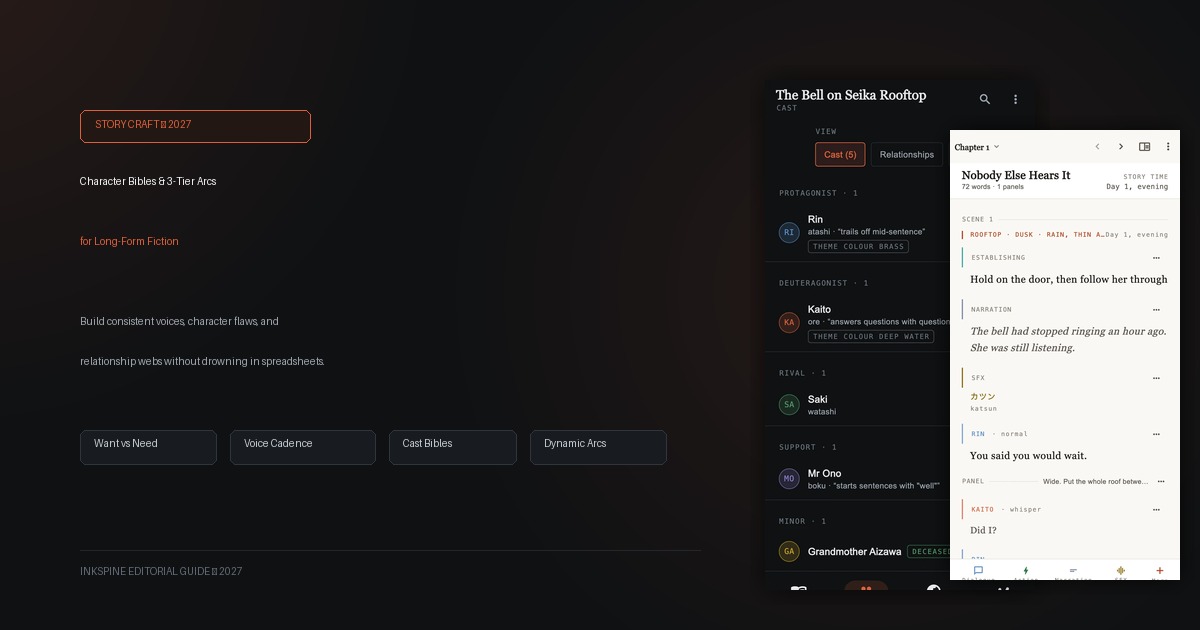
Inkspine includes a built-in Cast management tool. Keep character voices, motivations, and relationships right beside your active manuscript editor.
5. Mapping Relationship Friction
Characters do not exist in vacuums. They reveal themselves through friction with other cast members. A quick 3-point relationship summary between any two characters:
- What A thinks of B: "He’s a reckless amateur who will get us all killed."
- What B thinks of A: "She’s a cold snob who cares more about protocol than human lives."
- The shared secret: "They were the only two survivors of the 5th Expedition."
6. Managing Your Cast Inside Inkspine
Rather than keeping character sheets buried in separate Word files or complicated relational databases, Inkspine integrates your Cast directly into the workspace:
- One-Tap Cast Access: Switch from typing dialogue directly into your cast sheets to check speech cadence, relationship status, or character background.
- Offline Security: Your character sheets and manuscripts stay private on your device in local storage.
- Cross-Device Editing: Write on your Android tablet or desktop web browser with synced presence when you want it.