Co-Writing Fiction with a Partner: The 2027 Collaborative Writing Guide
Co-authoring a novel or serial fiction is thrilling—until file sync errors wipe out 3,000 words or a single Google Doc grinds to a halt. Here is how modern writing partners draft seamlessly.
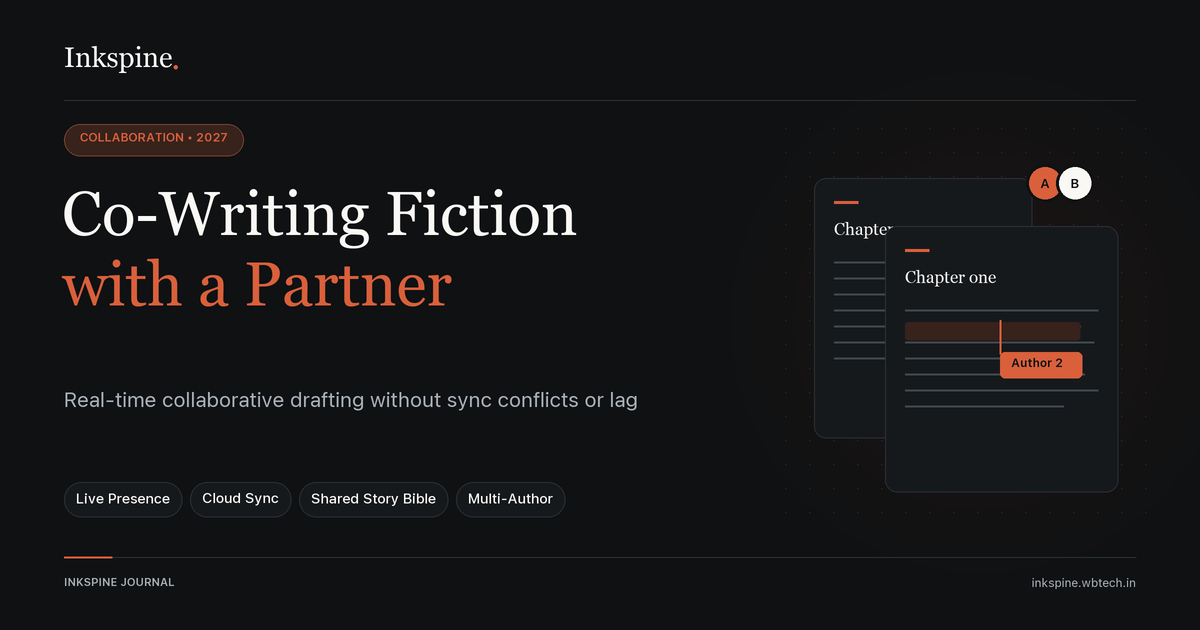
1. The Co-Writing Bottleneck: Scrivener vs. Google Docs
Fiction authors who decide to collaborate quickly encounter a frustrating technological dilemma:
- Scrivener has no real-time sync: Trying to share a `.scriv` package via Dropbox or OneDrive frequently creates "conflicted copies," corrupting metadata binders and locking authors out of concurrent edits.
- Google Docs lacks fiction architecture: While Google Docs offers flawless live cursors, it has no native concept of volumes, character dossiers, scene beats, or timeline ordering. Once a manuscript exceeds 50,000 words, mobile browser tabs lag and navigation becomes a nightmare.
Authors need a dedicated fiction environment with a structured scene binder, shared lore database, and live presence sync.
2. Four Proven Collaborative Writing Workflows
Before typing Chapter 1, co-authors should choose one of four operational models:
- Alternating POV (Point of View): Author A writes protagonist #1; Author B writes protagonist #2. This ensures each character has an authentically distinct voice.
- Architect & Wordsmith: One author outlines detailed scene beats, world rules, and plot twists; the other executes the prose and dialogue.
- Sequential Draft & Polish: Author A writes the rough, fast first pass (vomit draft); Author B does the line-level stylistic pass and pacing polish.
- Parallel Scene Drafting: Both authors write simultaneously in separate chapters within the same shared project binder.
3. The Shared Story Bible: Eliminating Consistency Drift
The most dangerous enemy of a co-written novel is "lore drift"—Author A writes that the magic academy has 4 towers, while Author B writes that it has 7.
To maintain unbroken continuity, both authors must have instant access to:
- Cast Profiles: Visual appearance, speech ticks, catchphrases, and character secrets.
- Terminology & Rules: Spells, technology limits, and fictional geography.
- Timeline Tracking: Who is where at what hour in story-time, preventing contradictory flashbacks.
Write together in real time with Inkspine.
Invite co-writers to your project with a single click. Enjoy live presence, shared character bibles, and instant offline backup across Android and the web.
4. How to Handle Editorial Disagreements
Creative friction is inevitable. Successful co-authors establish clear tiebreaker rules:
- The Character Veto: If you are responsible for character X, you have the final say on what character X would or wouldn't say in dialogue.
- The 24-Hour Cooling Rule: When debating a plot twist, write two 300-word outlines of both branches, sleep on it, and re-evaluate with fresh eyes.
- Kill Your Darlings Gracefully: If an author loves a scene that the partner feels slows the book down, cut it into a "deleted scenes" folder rather than deleting it permanently.
5. Real-Time Fiction Collaboration in Inkspine
Inkspine was built to bridge the gap between Scrivener's organizational power and Google Docs' fluid collaboration:
- Live Shared Presence: Sign in with Google, share a project invite, and write together inside the same scene or across different chapters.
- Shared Cast & Lore Bible: When your partner updates a character's backstory or adds a worldbuilding faction, it updates in your workspace instantly.
- Local Offline Fallback: Private projects remain 100% stored on your device. When writing offline, your drafts are safely buffered in local storage.
- Cross-Platform: One partner can write on an Android tablet while the other works in their desktop web browser.
6. Co-Author Launch Agreement Checklist
Before beginning your manuscript, agree on these 5 parameters:
- Target manuscript word count and volume split (e.g. 80,000 words, 4 parts).
- Weekly drafting quota per author (e.g. 3,000 words/week each).
- Which platform is used for drafting vs. where final export backups are saved.
- How author credits and royalties will be split upon commercial publication.
- Who holds the final editorial vision for series continuity.