Dan Harmon’s Story Circle for Manga & Light Novels (2027)
Why traditional 3-act film outlines stumble in episodic fiction, and how Dan Harmon’s 8-step Story Circle provides the ultimate plotting roadmap for manga arcs, webtoons, and serial sagas.
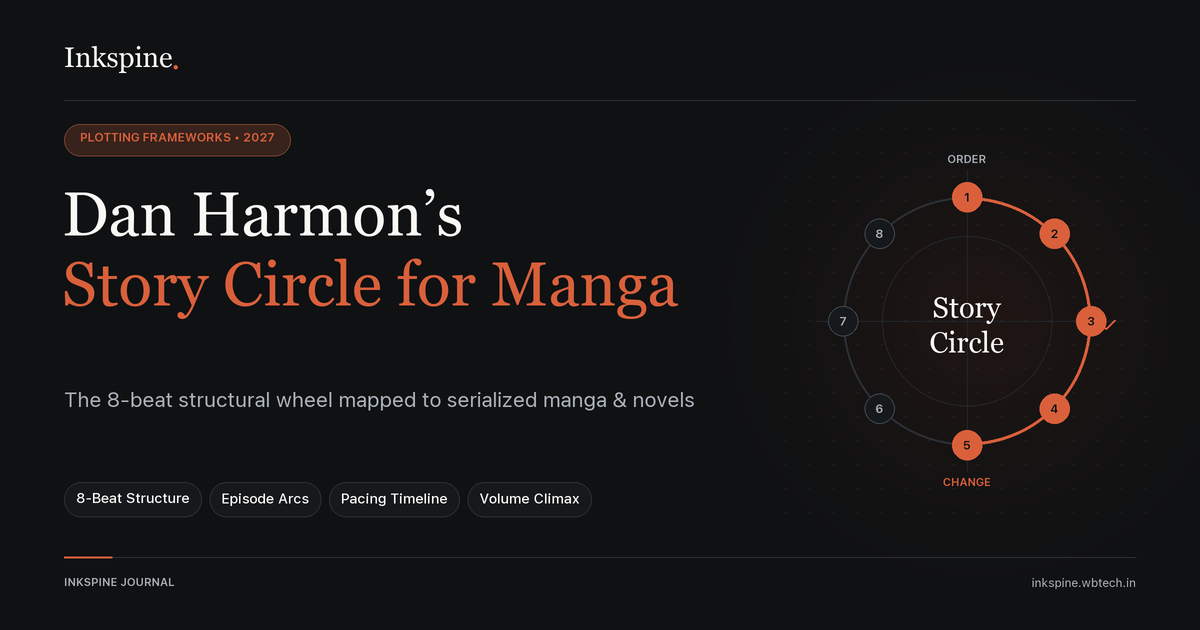
1. Why the Story Circle Fits Serial Fiction
Derived from Joseph Campbell’s Monomyth (The Hero with a Thousand Faces), Dan Harmon’s 8-beat Story Circle distills the classic journey into an intuitive cycle of psychological change.
Unlike rigid 3-act screenplays that require strict minute-marks, the Story Circle operates as an elastic loop. The top half represents order, comfort, and consciousness; the bottom half represents chaos, the underworld, and transformation. This makes it ideal for serialized manga, isekai light novels, and anime episodes.
2. The 8 Beats of the Story Circle
- 1. YOU (Zone of Comfort): Establish the protagonist in their baseline routine (e.g. Deku taking hero notes; Tanjiro selling charcoal).
- 2. NEED (Desire/Catalyst): Something is missing. An inner emptiness or external disturbance forces an urge to act.
- 3. GO (Crossing the Threshold): Entering the unfamiliar world. The old safety net vanishes.
- 4. SEARCH (Road of Trials): Trials, training montages, and clashes with early minions. The protagonist is tested.
- 5. FIND (The Centerpiece): Discovering what they sought (a powerful weapon, a revelation, or enemy headquarters).
- 6. TAKE (Heavy Price): A devastating consequence or loss. Victory comes at an agonizing cost.
- 7. RETURN (Heading Back): Returning to the threshold world with the prize, pursued by the final threat.
- 8. CHANGE (Transformed Mastery): Back in the ordinary world, but fundamentally altered. The status quo is permanently upgraded.
3. Applying the Circle to a 4-Chapter Manga Arc
Here is how a standard Shonen manga tournament or dungeon raid arc maps to the wheel:
CHAPTER 2 3. GO & 4. SEARCH — Enter the labyrinth. First monster encounter; teamwork fails.
CHAPTER 3 5. FIND & 6. TAKE — Boss door opens. A mentor is struck down; protagonist unlocks hidden power.
CHAPTER 4 7. RETURN & 8. CHANGE — Escape collapse. The guild registers their upgraded rank; new horizon beckons.
4. Scaling the Circle for Light Novel Volumes
In light novels (45,000–55,000 words), you can nest micro-circles inside a grander macro-circle. Each 3-chapter sequence completes a mini-trial (beats 1 through 8), while the entire book represents one grand cycle. This ensures readers experience satisfying resolution every 15,000 words while binge-reading.
Keep your story arcs and beats organized.
Inkspine's Timeline View lets you arrange scenes chronologically, track character presence, and group chapters into satisfying volume arcs.
5. Three Common Pitfalls to Avoid
- Skipping Beat 6 (Take): If the protagonist takes the prize without paying an emotional or physical price, the climax feels unearned and flat.
- Lingering Too Long at Beat 1: In web fiction, spend no more than 10% of chapter length establishing comfort before triggering the inciting spark.
- Forgetting the Internal Change (Beat 8): Upgraded armor or new magic levels are empty if the protagonist’s psychology hasn’t shifted.
6. Plotting Beats on Inkspine’s Story Timeline
In Inkspine, you don't need external corkboard software or whiteboards:
- Timeline View: See your scenes in story order with dedicated beat tags.
- Volume Grouping: Package multiple circles into volumes, seasons, or story arcs.
- Cast & World Connected: Tag which characters participate in each beat so relationship progression matches the plot wheel.