Webtoon Script Writing & Vertical Scroll Pacing Guide (2027)
Vertical scrolling changed visual storytelling forever. Learn how to write scripts tailored for continuous mobile thumb-scrolling, gutter pacing, and emotional tension.
1. The Vertical Pacing Mindset
In traditional print manga or Western comics, a reader takes in an entire two-page spread in an instant before reading panel-by-panel. In a vertical webtoon (such as on LINE Webtoon, Tapas, or Piccoma), the reader only sees one or two panels at any single moment.
This means the reader controls time with their thumb. As the screenwriter or creator, you orchestrate suspense by deciding how much distance exists between the cause of an action and its emotional payoff.
2. Pacing with Gutters: The Power of Empty Space
In print comics, gutters (the space between panels) are uniform margins. In webtoons, the vertical gap between panels is a storytelling weapon:
- Short gap (50–100px): Fast-paced action, rapid-fire dialogue exchanges, kinetic clashes.
- Long gap (300–600px): Dread, quiet realization, atmospheric passage of time, or long falls. As the reader's thumb scrolls through negative space or falling petals, anticipation builds.
- Full viewport reveals: Save full-screen splash panels for major transformation sequences, dramatic boss entrances, or tender romantic climaxes.
3. Webtoon Script Block Format
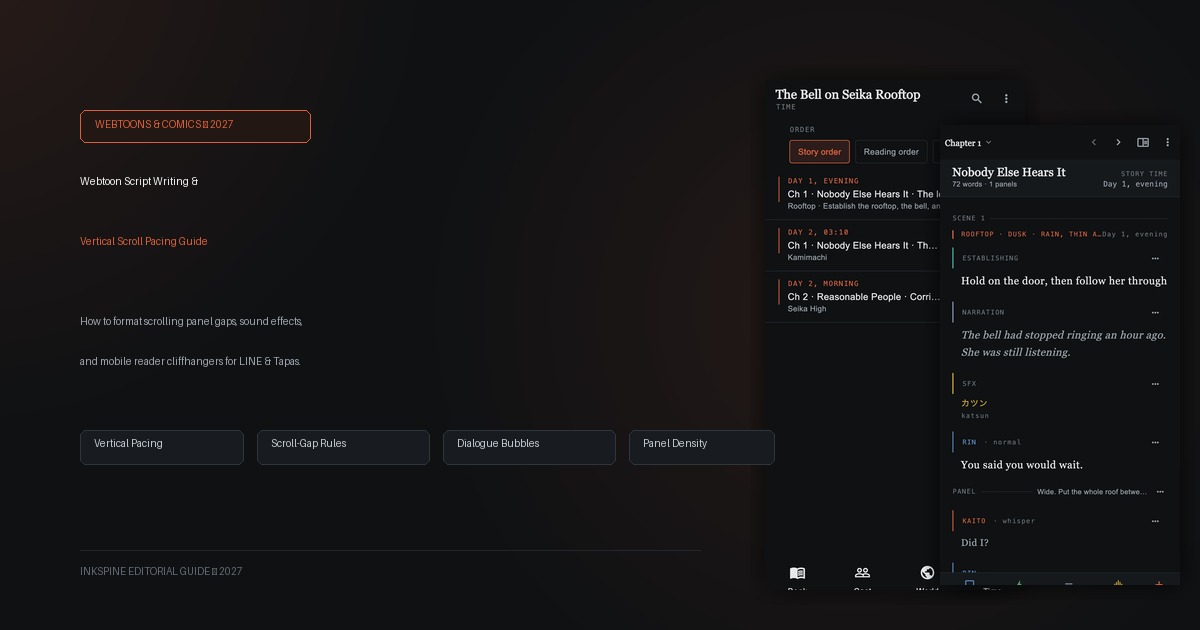
Here is how a clean, production-ready webtoon script looks when formatted in Inkspine's block editor:
PANEL 14 Wide horizontal crop: Soo-jin standing at the station turnstile.
SFX CHIK-CHIK (train wheels slowing down)
SOO-JIN "He told me he’d be on the last car."
GUTTER (Empty black background, silence beat)
PANEL 15 Extreme close-up: Her reflection in the train window as the doors slide open.
SFX SSSSSSH (pneumatic door release)
VOICE (off-panel) "Looking for me?"
4. The 30-Word Dialogue Rule for Phone Screens
Smartphone displays are narrow. A dialogue bubble containing more than 25 to 30 words covers half the visual artwork and overwhelms mobile readers.
- Cap at 2 sentences per bubble: If a character delivers an exposition monologue, break it into 3 consecutive small speech tails trailing down the scroll path.
- Avoid stacked dialogue: Do not place two rival characters speaking at the exact same horizontal height. Left-to-right reading order requires vertical stair-stepping.
- Use bold SFX blocks: In Korean manhwa and webtoons, sound effects are integrated graphic elements. Define their tone and placement directly in your script notes.
Script your webtoon without formatting headaches.
Inkspine includes dedicated manga/webtoon panel breaks, sound effect blocks, character cast profiles, and timeline planning on Android and the web.
5. Episode Cliffhangers & The Weekly Drop
Because webtoons update once per week, your script must secure high reader retention. Every episode (typically 40 to 60 panels) must conclude on one of three classic cliffhanger triggers:
- The Revelation: A secret is uncovered or an identity is revealed on the final panel.
- The Physical Threat: A blade is drawn, a curse is triggered, or a confession is interrupted.
- The Moral Dilemma: A character is forced to choose between two impossible consequences before the episode fades to black.
6. Writing Webtoons Offline in Inkspine
Whether you script solo or collaborate with an illustrator, Inkspine provides the ideal environment for visual storytellers:
- Panel & SFX Blocks: Type scenes with native panel numbers, establishing shots, and sound effect tags.
- Character Visual Sheets: Store character outfit references, color palettes, and relationship notes right next to your script.
- Export to Fountain & Markdown: Seamlessly export your script for letterers, artists, or publishing platforms.
- Works Anywhere: Available on Android tablets, phones, and the browser with zero forced cloud accounts.